

Cart 0
Private Label USB Charger: Guide to Custom Power Solutions
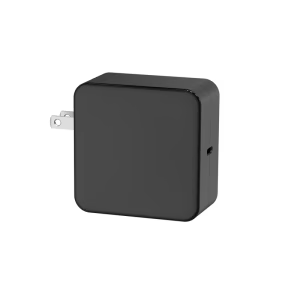
In today’s tech world, USB chargers have become essential. We are able to charge almost any device with it. If you’re willing to invest some money for the sake of organizing your branded accompaniments, a private label USB charger will surely help you do so. Through a private label option, businesses can create signature chargers that can provide your customers with a high-quality solution for charging as well. In this piece, we consider the benefits of wholesale private label USB chargers as well as selecting your supplier and how branded products can help your business.
What Is Private Label USB Charger Exactly?
A private label USB charger is produced by a third-party supplier who sells it under a retailer’s or business’s tag. Custom charger manufacturers often customize the chargers as per company specification using our brand colors, packaging and so. At times even qualities. A firm may cross sell quality products under its own brand without engaging in production.
In numerous sectors, especially electronics; retailers are adopting more private labelling to entice consumers to purchase their private label brands with customized products. One of the main advantages of private labeling a USB charger is that it allows a company to sell and promote products that reflects their brand. A professional image can be established through this.
What Makes Private Label USB Chargers Attractive?
- Brands can customize the look and feel of the charger and pack as per their discretion.
- Private labeling is cheaper as you do not have to manufacture.
- A trustworthy vendor will never compromise on charger quality. The chargers must adhere to the UL standard and international safety standards.
- Your brand will stay fresh in the consumer’s memory with customized chargers.
Perfect for Electronic businesses, retail chains, and hospitality, private label chargers can enhance the overall customer experience through branded accessories and reliable charging solutions.
Private-label manufacturing does not mean substandard products
When companies choose a USB charger with a private label, they can customize anything they want. Customization extends well beyond a logo and packaging. Businesses can customize these key features.
1. Personalized design and packaging
Design is pivotal to developing products sold under a private label. Thanks to private-label USB chargers, businesses have plenty of choices for different styles, shapes, sizes, and colors according to their needs. Insulation is most often applied to the boxes and cases that carry the brand message and logo. Packaging can be personalized according to the needs.
2. Specifications and Output of Power
The company can choose the power output of a USB charger as per the devices it charges. For example, the faster charging may require a high-power charger for smartphones, tablets or other electronics, while a low-powered charger is enough for a smaller device such as a wireless earphone. The charger we are going to discuss comes with provide custom power output specification. It means it will be as per your need.
3. Types of Connectors
Depending on the intended devices, the private label USB chargers come in three types of connectors; USB-A, USB-C and micro-USB. USB-C is increasingly becoming popular for fast charging and high-speed data transfers, for instance. Supplier should provide connector options flexibly to suit customer’s requirements.
4. Safety and compliance clauses
Safety is a major issue when it comes to electronics. The power supply is important in power products like USB chargers. A UL certified charger has undergone rigorous testing for safety and has been certified as safe. Your supplier must make chargers with the right certifications when making your choice. This will keep your brand and customers safe.
Advantages of custom branded USB chargers
USB Chargers are private label goods that give various advantages to the business. Here’s how private label USB chargers compare to regular chargers and advantages they offer.
| Feature | Private Label USB Charger | Standard USB Charger |
| Branding | Fully customizable with company logo | Generic design, no branding options |
| Quality Control | High-quality with safety certifications | Varies depending on the manufacturer |
| Customer Perception | Higher perceived value with branded products | Lower perceived value, generic look |
| Market Differentiation | Differentiates business in competitive markets | No differentiation from competitors |
Comparison of Brand Visibility Between Private Label vs. Standard Chargers
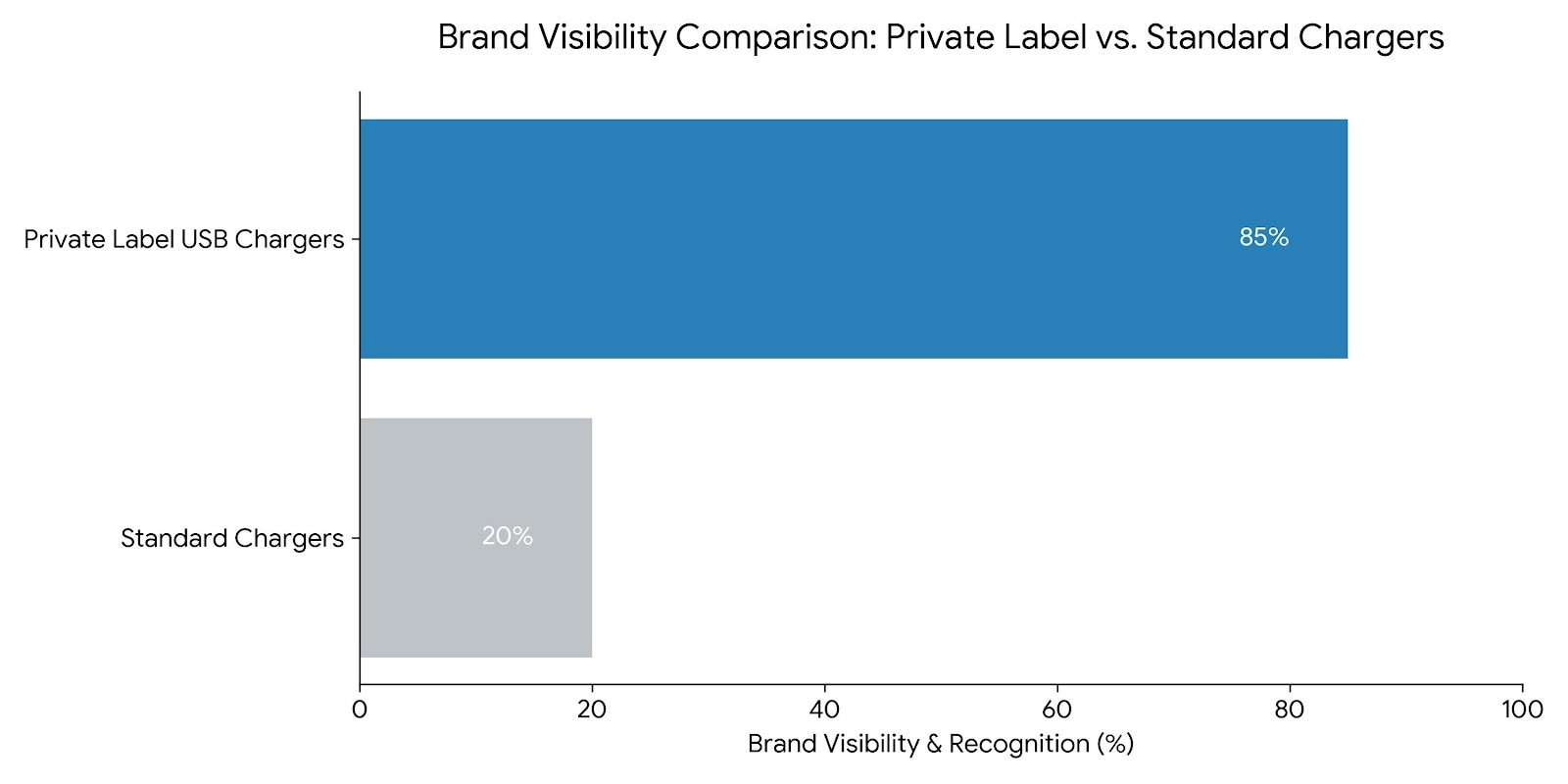
- When someone is charging their device, which is arguably the most frequent action in people’s daily life, your logo will be 85% in view.
- Most consumers have only seen 20% of the standard chargers in the market but that is something we swipe left and don’t give it a thought.
- The charger is something we use at home, at our office or during travel because of which the application of private labeling. It will make it a charger that is a utility turn marketing device. Further, it will make it a charger everywhere.
Suppliers of Private Label USB Chargers: How to choose?
It is very important to choose the right supplier of private label USB chargers. This is because the supplier will affect the product quality, delivery time, and other customization options. A guide to help businesses choose the perfect supplier.
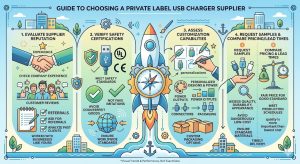
1. Look at the suppliers review from the company
Supplier of USB Chargers First of all, try to evaluate suppliers’ experience and reputation. Find suppliers who are known for providing quality goods and satisfaction. Check customer reviews, ask for referrals, and analyze whether the supplier has worked with businesses like yours.
2. Check for licenses and certifications
Ensure the supplied USB chargers meet suitable safety standards (like UL and CE) and are not fake imitations. It’s safe to use these chargers according to worldwide standards, as the certificates show.
3. Check out the capabilities of customization
Make sure the supplier gives the personalization you want. Charger designs, power outputs, connectors and packaging are some of these. A supplier that offers flexible customization will help you get chargers that are tailored to your brand and product specifications.
4. Request For Samples
Request test samples of USB chargers to assess quality prior to placing large orders. In this way, you can assess the quality, sturdiness and appearance before buying them in large quantities.
5. Pricing and lead times are other aspects to consider
While cost definitely matters, it is not the only consideration. Don’t let low-cost suppliers dangerously cut quality and return damage your brand and company. Ensure that the contractor’s materials are of good standard and a fair price You should also check lead times to ensure they can meet your production schedules.
Conclusion of the Text
Businesses can offer their customers unique branded chargers to power their devices by creating a private label USB charger with their brand name. When you collaborate with a reliable supplier, you obtain quality materials that correspond with your brand, integrating brand image and creating satisfied customers. It is possible to design a normal charger or a private label charger with plenty of features to suit the capsule charger segment.
The right supplier can enhance your product line and brand image with USB chargers you sell under your own label. Shenzhen Sunray Technology Limited provides reliable charging solutions designed to meet the needs of modern consumers while helping strengthen your business.
Continue researching
Questions readers usually ask next
See how private label USB charger projects move from concept to launch, including branding, compliance, product selection, and supply.
Planning points worth checking early
These notes are here to make the next comparison or sourcing step more concrete.
What this clarifies
Use the article to narrow the next technical or sourcing question instead of staying broad.
What to compare
Check the closest related product family, requirement, or compliance route next.
When to ask
Move into contact or quotation once the issue is specific enough to affect feasibility or timing.
Keep comparing options
These references help visitors move into the most relevant next comparison or conversation.
01
OEM Charger Manufacturer
See how oem charger manufacturer supports the next product, sourcing, or factory-planning decision.
02
Request a Quote
Share the project scope, target markets, and volume expectations to move into a practical quotation discussion.
03
Contact Us
Reach the team directly for technical questions, sampling requests, and sourcing follow-up.
Questions readers often ask next
Each answer is written to help the next decision feel more concrete.
What makes a private label USB charger program commercially viable?
A private label program usually works best when the product has a clear target market, realistic volume potential, and defined packaging or brand presentation requirements. Teams often compare consumer charger manufacturing with the broader OEM and ODM route before finalizing direction.
Can packaging and branding be customized without changing the core charger platform?
Often yes. Many private label charger projects start from an existing electrical platform, then adjust housing finish, label content, carton design, inserts, and regional presentation to match the brand without restarting development from zero.
What should a buyer verify before choosing a private label USB charger supplier?
The practical checkpoints usually include charger safety, documentation discipline, sample quality, output consistency, packaging control, and the supplier’s ability to support repeat orders across the same approved version.
When should a buyer move from article research to a live quote discussion?
Once the charger type, target market, and brand direction are clear enough to compare MOQ, packaging, and compliance options, a direct quote request is usually the fastest next step.
Need help turning this reading into a product decision?
Share the application, target output, and destination markets if the article has narrowed the next discussion enough to review practical options.